Trent Anderson
The Lost SymbolTrent Anderson is the veteran security chief of the United States Capitol, responsible for coordinating its officers and surveillance systems. When Mal’akh leaves Peter Solomon’s hand in the Capitol Rotunda, Anderson directs the immediate response, but the case quickly exceeds his ordinary remit: Inoue Sato asserts control, and the symbols on the hand lead the investigation into the concealed chamber marked SBB XIII. Anderson’s arc turns on the distance between controlling a building and understanding what has been hidden inside it.
Identity and Responsibilities
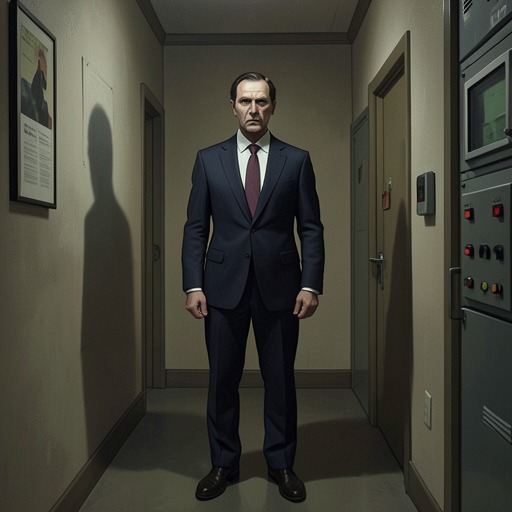
Anderson has overseen security in the United States Capitol Complex for more than a decade. He is described as square-chested and powerfully built, with a chiseled face and close-cropped red hair; his visible sidearm reinforces the authority he projects while directing the officers under his command. Much of his work takes place in a basement surveillance center, where technicians monitor cameras and computer displays and maintain the communications network linking Capitol security staff.
On the evening the crisis begins, the operations room appears routine enough that Anderson hopes to watch a football game on the television in his office. The disturbance in the Capitol Rotunda interrupts that ordinary shift. A technician draws his attention to an east-balcony recording, and Anderson studies the footage as a security problem: an injured-looking man, moving with a limp and carrying an arm sling, behaves differently from the tourists around him. The recording catches the man stopping at the Rotunda’s center, leaving an object, and departing. Anderson’s authority is practical and immediate; he responds by ordering officers to identify and detain the suspect.
The Rotunda and the Escaping Suspect
Anderson acts on the visible evidence and the building’s layout. Since the suspect appears to have left through the east portico, Anderson calculates that the east-west corridor offers the shortest route out and runs there to intercept him. He asks a tourist in a blue blazer whether he has seen the man with the sling. The tourist directs Anderson toward a staircase, and Anderson relays that route to the teams over his radio.
The apparent lead is a deception. Mal’akh has removed the surplus jacket and sling in a darkened alcove, put on a blond wig, and emerged in the blue blazer with a guidebook, walking upright rather than limping. Anderson pursues the identity presented by the surveillance footage and the misleading witness account; Mal’akh uses the change of clothing and posture to pass through the exit. The failed interception reveals a vulnerability in the response: camera coverage supplies details, but those details can be manipulated, and a fast-moving search can be sent in the wrong direction.
Afterward, Anderson returns to the Rotunda to contain the scene. His officers close the entrances with temporary crowd-control measures and gather the witnesses, collecting their phones and cameras to limit the spread of images. He inspects the object left at the center of the room: a real human hand mounted upright on a wooden base, bearing a ring with a two-headed bird and the number 33, as well as fingertip markings. Anderson notices details relevant to the investigation but cannot identify their meaning. The scene is both a security incident and a message whose significance lies beyond his expertise.
Working Under Inoue Sato
Anderson’s local authority is sharply tested when Inoue Sato, director of the CIA Office of Security, calls and arrives at the Capitol. She takes control of the investigation, characterizing it as a national-security matter rather than an ordinary Capitol security case. Anderson objects that the incident does not naturally fall within her office’s domain, but Sato outranks him in the confrontation and directs him to cooperate. His response is a mixture of professional insistence and submission to a superior authority: he maintains that his officers have responsibilities, yet he yields when Sato makes clear that she is taking over.
The difference in their approaches is visible in how they interpret the hand. Anderson wants forensic examination and initially treats the object as evidence to be processed. Robert Langdon recognizes the ring and hand as Peter Solomon’s and explains that the fingertip markings form the Hand of the Mysteries, an ancient invitation associated with secret knowledge. Anderson cannot supply that interpretation, but he helps verify the physical clue: when Langdon predicts that the concealed fingertips are marked too, Anderson checks and confirms that all five carry tattoos. The investigation depends on the exchange between Anderson’s access to the scene and Langdon’s knowledge of its symbols.
SBB XIII and the Hidden Chamber
When Langdon turns the hand’s base upside down, its markings yield SBB XIII, a designation Anderson recognizes as belonging to a Capitol numbering system. He confirms that the label points toward a location below the building and, at Sato’s direction, arranges access. The route is not familiar territory even to him. In the lower corridor, he has to orient himself by the descending Senate Basement numbers and then the ascending House Basement numbers; the SBB door stands at the boundary between them. Its marking is so faded that Langdon nearly misses it.
The access arrangements underline how thoroughly the area has fallen out of routine use. Staff struggle to locate the original key, and the records indicate that nearly all the storage rooms in the SBB have been emptied and abandoned for years, with SBB XIII the exception. Anderson leads Sato and Langdon along a passage of similar, apparently unused rooms. The door to SBB XIII is closed, unlike the others, and its copper number plate repeats the characters found on Peter Solomon’s hand. When the ordinary key does not open it, the group must decide whether to force entry. Anderson is uneasy about the prospect, but he remains part of the search that the clue has set in motion.
Inside, Anderson directs his flashlight through a narrow stone chamber. Its sparse contents include a skull and leg bones arranged with an antique hourglass, a crystal flask, a candle, two saucers of powder, a sheet of paper, and a scythe. Langdon recognizes the setup as one found in similar chambers elsewhere and identifies the powders as salt and sulfur. Anderson’s discovery is therefore not simply an abandoned storage space: it is a deliberately arranged Chamber of Reflection, a ritual setting whose meaning Anderson does not know in advance. The contrast recurs throughout the investigation—his access and command bring the group to the hidden place, while symbolic knowledge makes its contents legible.
Setbacks and the Limits of Command
Anderson’s difficulties continue after the underground discovery. Capitol officer Nuñez helps Warren Bellamy and Langdon escape, and Anderson later reviews surveillance playback with Sato and the security team to determine where they went. Nuñez approaches him privately, admits his role, offers to resign, and gives him a key to the tunnel under Independence Avenue that Bellamy used. Anderson has an ice pack against his head; Nuñez says Bellamy struck him during the escape. Even after receiving the key, Anderson cannot simply keep the information from Sato: she appears in the hallway, sees it, and identifies the tunnel herself.
Anderson is not portrayed as incompetent so much as bounded by the assumptions of his post. He knows the building’s corridors, controls the surveillance response, and recognizes the SBB designation, but he is repeatedly forced to revise his understanding as the case turns from a planted object into a coded summons, a sealed chamber, and a national-security crisis. His attempts to intercept Mal’akh and later to account for Langdon’s escape show how quickly the building’s apparent order can be unsettled. In the plot, Anderson supplies the institutional and physical infrastructure of the investigation, while the crucial meanings emerge from evidence he can secure but cannot interpret alone.